



Why Capacitance Manometers Matter for Process Repeatability
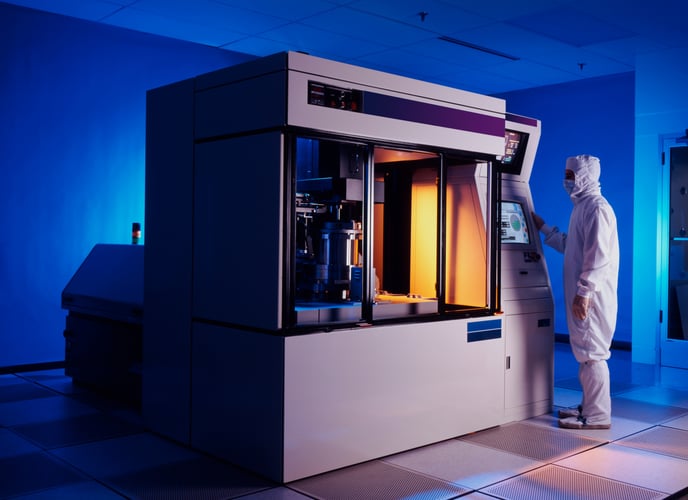
In semiconductor manufacturing, chamber pressure is a critical process variable. Whether performing plasma etch, thin-film deposition, or operating vacuum subsystems that support EUV lithography, even small pressure variations can impact process consistency, yield, and equipment performance.
Accurate vacuum measurement enables process engineers to maintain stable operating conditions, control process recipes, and improve chamber-to-chamber matching. That's why capacitance manometers have become a widely used pressure-measurement technology in semiconductor manufacturing.
The Role of Pressure in Semiconductor Processing
Vacuum pressure directly affects how gases behave inside a process chamber. During plasma etch, pressure influences ion energy, chemical reactions, etch profiles, and wafer uniformity. In deposition processes such as CVD, PECVD, PVD, and ALD, pressure impacts precursor transport, film growth, thickness uniformity, and contamination control.
For EUV lithography and supporting vacuum systems, maintaining proper vacuum conditions is essential because EUV light is readily absorbed by air and contamination can degrade optical performance.
Across these applications, stable pressure measurement helps ensure repeatable process results from wafer to wafer and tool to tool.
Why Engineers Choose Capacitance Manometers
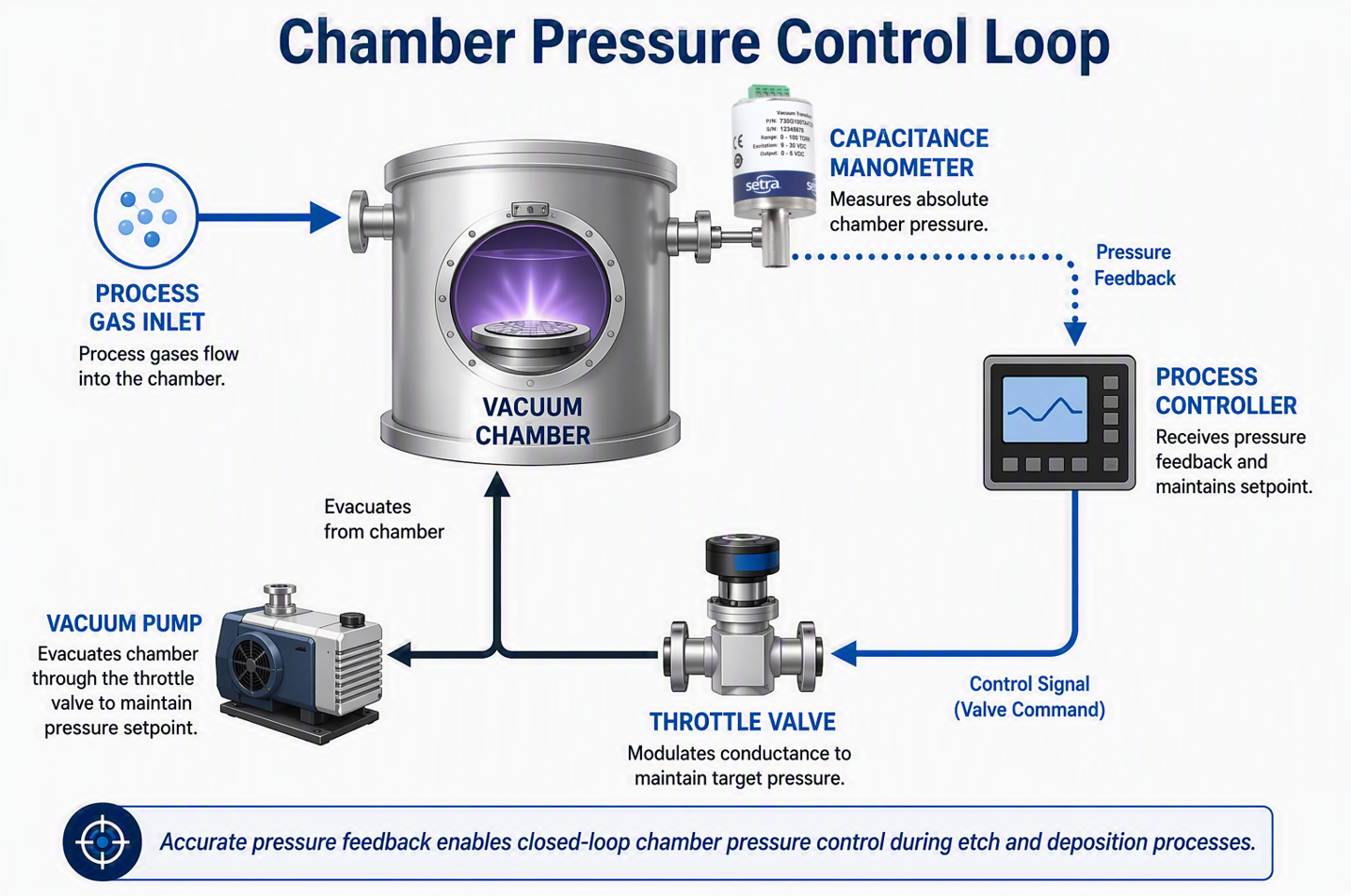
Unlike some vacuum measurement technologies whose performance can vary with gas composition, capacitance manometers directly measure pressure through diaphragm deflection. This provides highly accurate, gas-independent pressure measurement that remains consistent across changing process chemistries.
For semiconductor equipment manufacturers and fabs, this means:
- Improved process repeatability
- More stable chamber pressure control
- Better chamber-to-chamber matching
- Reduced measurement uncertainty across different gases
- More reliable closed-loop pressure control
As process windows continue to tighten at advanced technology nodes, accurate pressure feedback becomes increasingly important to maintaining yield and throughput.
Common Vacuum Measurement Challenges
Vacuum sensors used in semiconductor equipment must perform reliably despite challenging process environments:
Changing Gas Chemistries
Different etch and deposition recipes use different process gases. Measurement technologies that depend on gas properties can introduce unwanted variation.
Harsh Process Conditions
Many applications involve corrosive gases, reactive byproducts, and frequent chamber-cleaning cycles, all of which can affect sensor performance.
Fast Pressure Transitions
Pump-down cycles, pressure stabilization steps, and recipe changes require sensors that can respond quickly enough to support closed-loop control.
Tight Process Tolerances
Modern semiconductor manufacturing demands highly repeatable pressure measurement to maintain consistency across production tools and facilities.
Product Fit: Model 730 Vacuum Capacitance Manometer from Setra Systems
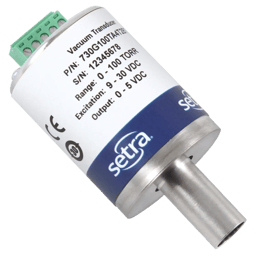
Setra’s Model 730 is a high-accuracy absolute capacitance manometer designed for low-vacuum pressure ranges and used in semiconductor, photovoltaic, and industrial process control applications. It is positioned for demanding vacuum measurement where repeatability, gas-independent measurement, and process-compatible wetted materials matter.
Key Model 730 features for semiconductor applications:
- Capacitance diaphragm gauge technology: The Model 730 uses a variable capacitance sensing element for demanding semiconductor and industrial vacuum applications.
- Direct pressure measurement: The Model 730 measures pressure directly, and its output is independent of process gas composition.
- Accuracy options: ±0.5% of reading standard accuracy and ±0.25% of reading optional accuracy.
- Fast response: Less than 20 ms.
- Low noise and high resolution: Resolution is limited only by output noise level, with output noise listed at ≤0.005% full scale.
- Process-compatible wetted design: Inconel wetted material for aggressive semiconductor media, and welded nickel alloy wetted components.
- Pressure range options: Torr, mbar and kPa configurations, including 10, 20, 100, 200 and 1000 Torr options, plus corresponding mbar and kPa ranges.
- Analog output options: 0 to 5 VDC and 0 to 10 VDC output options.
- Industry-standard fittings: 0.5 in OD tube, ISO NW10, ISO NW16, ISO NW25, VCR internal swivel options and NPT configurations.
- Compliance: CE and RoHS compliance.
Where the Model 730 Fits Best
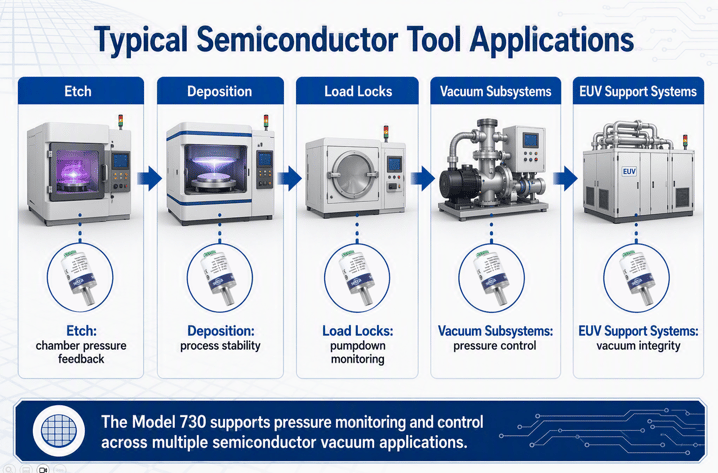
The Model 730 is a strong fit for semiconductor equipment and subsystem locations that require accurate low-vacuum absolute pressure measurement, fast response, and compatibility with aggressive gas environments. Typical fit areas include:
| Equipment or subsystem | Application needed | Why capacitance measurement matters |
| Plasma etch tools | Chamber pressure feedback during recipe steps | Supports repeatable ion energy, plasma behavior, and etch uniformity |
| PECVD, LPCVD, and ALC tools | Pressure control during deposition, purge, and precursor exposure | Helps maintain film uniformity, dose repeatability, and chamber stability |
| Vacuum process modules | Absolute pressure monitoring and control | Provides gas-independent measurement for changing recipe gases |
| Load locks and transfer environments | Pump down and stabilization monitoring | Helps support repeatable wafer transfer and tool sequencing |
| Gas delivery or process interface vacuum points | Low-vacuum pressure verification | Supports control and diagnostics in gas-handling subsystems |
| EUV-supporting vacuum subsystems | Pressure monitoring in compatible range locations | Helps support contamination control and vacuum integrity, subject to tool-specific range and material validation |
Selection Considerations for Engineers
When specifying a capacitance manometer for semiconductor tools, engineers should confirm:
- Pressure range and full-scale value:
Select the closest full-scale range to the process control window while preserving overpressure margin. - Wetted material compatibility
Validate all wetted materials against process gases, by-products, and cleaning regimes. For the Model 730, review the specific wetted material notes by fitting option in the data sheet. - Accuracy requirement
Consider whether the standard ±0.5% of reading accuracy is sufficient or whether the optional ±0.25% of reading accuracy is needed for tighter process matching. - Response time and control loop requirements
Fast pressure transitions may benefit from the Model 730’s specified response time of less than 20 ms. - Signal interface
Match the output option, 0 to 5 VDC or 0 to 10 VDC, to the tool controller or subsystem electronics. - Fitting and installation environment
Confirm flange, tube, or VCR fitting requirements and any cleanliness, leak rate, or maintenance expectations.
Better Vacuum Measurement Enables Better Process Control
As semiconductor devices become more complex, process windows continue to tighten. In etch, pressure affects plasma chemistry, ion behavior, and uniformity. In deposition, pressure stability supports film quality, precursor control, and contamination management. In EUV systems and supporting vacuum environments, pressure control contributes to system integrity and contamination reduction.
Capacitance manometers matter because they provide accurate, direct, and largely gas-independent pressure measurements in the vacuum ranges where many semiconductor process tools require repeatable feedback. For tool builders and fabs looking to stabilize chamber pressure control, improve process matching, and support long-term reliability, Setra’s Model 730 offers a practical measurement solution with semiconductor-relevant accuracy, response, wetted materials, and configuration options.