
Setra Blog


October 15, 2015

Accuracy: End Point Method vs. Best Fit Straight Line Method

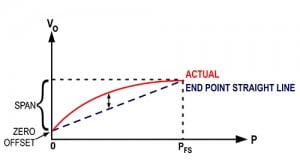
Which method provides better accuracy?  Non-linearity as the End Point Method is the relationship of the calibration curve to a specified straight line through its endpoints (i.e. Zero and Full Scale). Best Fit Straight Line (BFSL) method is the relationship of the calibration curve to a calculated straight line that minimizes the error but does not pass through the end points. BFSL method effectively cuts the end point value in half.

Continue Reading →

October 13, 2015

What Does Shock & Vibration do to a pressure transducer?

Shock & Vibration Are 2 Potential Mechanical Problems for transducer

There are numerous environmental factors that may interfere with the performance of a pressure transducer.  Two factors that sometimes overlooked to engineers are shock and vibration. Knowing the system where the pressure transducer is installed can help avoid high shock and vibration conditions, minimizing premature failure of your instrumentation. Before understanding the risks associated with shock and vibration, how a pressure transducer may experience or encounter these effects must be defined. 

Shock is a sudden, unexpected impact that transmits energy

Continue Reading →

October 01, 2015

Vacuum Pressure: What is it & how do you measure it?

The term vacuum is often misunderstood. Consequently, it is commonly misapplied when discussing pressure measurements and choosing pressure transducers. Pressure is the exertion of force upon an object. However, pressure can be measured in many different ways, depending on the applications.

Continue Reading →

September 21, 2015

6 Ways to Prevent Pressure Transducer Failure

If pressure transducers are exposed to a manufacturing environment that exceeds the suppliers specified limits, sensor issues will occur. during storage or assembly. An original equipment manufacturer (OEM) design engineer should take note of the following six conditions while designing a system to be manufactured and shipped to an end-user.

Continue Reading →

September 10, 2015

How Does the DASI System Use Barometric Pressure?

Barometric altimeters calculate and display altitude by measuring the local barometric pressure and converting that measurement into altitude. This conversion is done using the Standard Atmosphere Table, an international standard representing the barometric pressure at various altitudes on a so-called "standard day" which assumes a consistent non-linear relationship between altitude and pressure. Barometric pressure is used in absolute pressure datums to ensure repeatable measurement

Continue Reading →

August 27, 2015

Energy Management: A Little Awareness Can Go a Long Way

Knowledge is power. This statement has been thrown around a lot, but it really holds true. Being aware and having insight can lead to being proactive instead of reactive. Knowing the facts about an issue can not just fix them but give lasting solutions. One issue that greatly impacts the majority of the world is energy usage. With resources being depleted every year, energy monitoring allows for consumption awareness on any kind of level.

Continue Reading →

August 24, 2015

New Technology Featured at 2015 NCSL International Workshop & Symposium

This year's NCSL International Workshop and Symposium took place July 19th through the 23rd in Grapevine, TX, which brought together measurement industry professionals and thought leaders under one roof. The theme for the 2015 NCSL International Workshop & Symposium focused on “Measurement Science and the Quality of Life", which emphasized the role measurement science plays

Continue Reading →

August 20, 2015

10 Questions To Ask Before Selecting a Humidity Sensor

When selecting a relative humidity (RH) sensor, there are many factors to keep in mind that can contribute to longer product life and a successful project.  Being aware of the environmental conditions where the sensor will be installed can help determine the correct product specification for the sensor. Every application has its own challenges and requirements. To ensure that you choose the correct RH sensor for your application, ask the following 10 questions:

1. What RH range do I need to measure?
Continue Reading →

August 13, 2015

How to Determine the Best pressure Sensor For Tank Level Applications

A common concern surrounding tank level measurement is selecting the right type of sensor technology. Selecting the proper sensor technology will ultimately be determined by the conditions within the tank. The first thing you need to determine is if your vented tank is above ground or buried in-ground. An above ground tank will typically have a process connection external near the bottom of the tank, providing easy access to the sensor. A tank that sits in-ground will typically have an access hatch, where you can install your tank level sensor. Hydrostatic (gauge), capacitance, resistive and ultrasonic sensors are most commonly used for more critical tank level applications. Although they all measure liquid level, they work in different ways.

Continue Reading →

August 06, 2015

3 Reliable Methods of Medical Sterilization

One of the most vital processes within critical environments is the sterilization of medical tools and devices. Patient safety relies heavily on the efficiency and reliability of sterilization devices. Contaminants can become highly resistive to disinfection, which results in the need for high performance sterilization methods that will ensure sterile equipment. Three primary methods of medical sterilization occur from high temperature/pressure and chemical processes.

Continue Reading →