



In differential pressure measurement systems, the valve manifold affects instrument protection, maintenance procedures, and long-term measurement stability. Improper pressure equalization or trapped process media can result in sensor damage, inaccurate readings, or unsafe servicing conditions. Thus, knowing how to choose between the 3 and 5 valve options for the Setra Model 230 wet-to-wet pressure transducer is essential.
Valve Functions and Manifold Architecture
Both 3- and 5-manifolds consolidate multiple flow control functions into a single block to reduce leaks, simplify tubing, and protect the sensor element from excessive or unbalanced loading. The choice between the two configurations lies in how much control the user needs over isolation, equalization, venting, and test access.
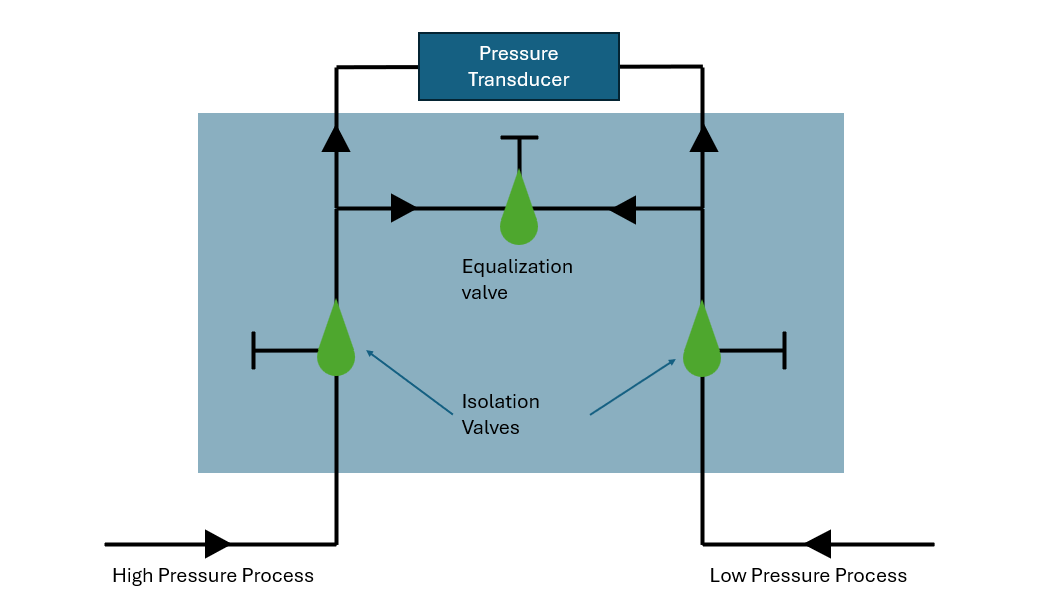
The 3-valve manifold consists of an isolation valve on each high- and low-pressure port and an equilibrating valve connecting the two. The isolation valves allow the entire instrument to be fully separated from the process, while the equalizing valve balances pressure between the two lines and across the sensor.
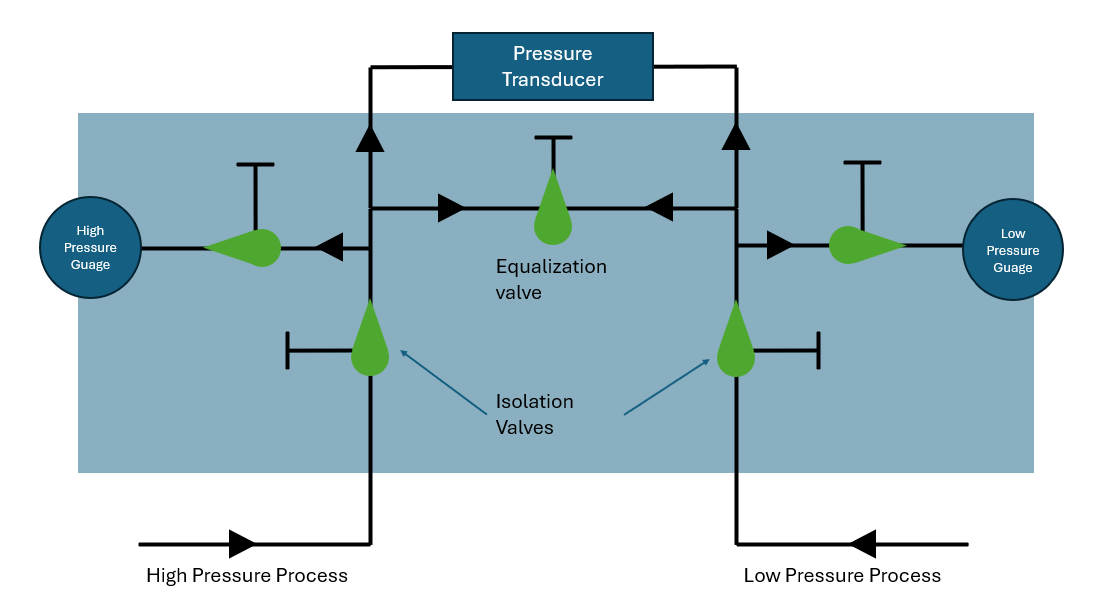
A 5-valve manifold incorporates these same valves and adds two more. These valves are connected to the process lines for test and measurement access, such as connecting external gauges for independent verification while the transmitter remains installed. The Setra Model 230 5-valve option also includes integrated bleed screws to safely relieve trapped pressure or purge process media before calibration.
Application Suitability of the Setra Model 230
The Setra Model 230 is designed to handle liquid media without exposing the sensing element to contamination or phase-change errors caused by gas/vapor pockets. This makes the Model 230 best suited for industrial processes that require reliability and mechanical robustness.
Typical Applications for the Setra Model 230
-
Filter condition monitoring
-
Pump performance evaluation
-
Heat exchanger differential pressure measurement
-
Flow indication for primary flow elements
-
Hydraulic systems
-
Efficiency, fouling, or blockage indication
Determining Whether a 3-Valve or 5-Valve Manifold is Appropriate
A 3-valve manifold is typically well suited for applications with relatively stable process conditions, where the differential pressure transmitter is installed for continuous monitoring and is rarely disturbed once commissioned. In these systems, isolation and pressure equalization are sufficient for safe startup and shutdown, and there is little need for frequent calibration or on-line pressure verification.
Typical Applications for the Setra Model 230 3-Valve Manifold
-
HVAC
-
Water treatment
-
Utility services
A 5-valve manifold is designed for complex systems with higher failure risks. The additional valves allow independent access to and verification of high and low side pressures without removing the transmitter. For applications that require routine, redundant testing, the 5-valve manifold is advantageous.
Typical Applications for the Setra Model 230 5-Valve Manifold
-
Chemical processing
-
Oil and gas
-
Power generation
-
Pharmaceuticals
Conclusion
The Setra Model 230 is a choice about control, safety, and maintenance. The 3-valve manifold is a streamlined solution for stable, low-risk applications where basic isolation and equalization are sufficient. The 5-valve manifold provides enhanced features for verification and diagnostics, and more demanding maintenance.
By understanding the functional role of each valve, users can ensure that their differential pressure measurement system operates safely, accurately, and reliably.