



How Does Accurate Pressure Measurement Improve Semiconductor Process Yield?
Semiconductor manufacturing depends on process stability. From gas cabinets and gas sticks cabinets and gas sticks, to process tools used in etch, deposition, lithography, ion implantation, and wet cleaning, fabs and tool builders must control specialty gases with a high degree of repeatability.
Accurate pressure measurement does not improve yield visibility by itself. Instead, it helps reduce one important source of process variation by supporting stable gas delivery, contamination control, leak integrity, and repeatable process conditions. NIST (National Institute of Standards and Technology) notes that accurate metering of semiconductor process gases into the process chamber is critical for maximizing device throughput and yield, and that process variation can reduce device yield.
Why Does Pressure Control Matter in Gas Delivery?
Semiconductor fabs rely on complex gas delivery systems to store, mix, purge, and deliver process gases safely and consistently. These systems may support highly corrosive, toxic, or pyrophoric gases used in critical wafer fabrication steps. Setra Systems identifies reliable pressure sensing as a key need for both semiconductor fabs and tool makers working with corrosive gas delivery in front-end wafer fabrication.
When pressure conditions are not well controlled, process variation can increase. In semiconductor manufacturing, that variation matters because gas delivery and control are recognized as essential to optimized yields, and components that reduce contaminants or improve delivery of essential gases can provide a competitive advantage.
For process engineers, mechanical engineers, facilities teams, and maintenance engineers, pressure measurement provides a critical signal for understanding whether gas delivery is operating within expected conditions. Pressure changes may not be apparent without real-time or historical data and may only become visible after wafer quality or productivity is affected.
Contamination Control Starts with Sensor Design
In ultra-high-purity gas systems, pressure measurement is closely tied to cleanliness. Semiconductor manufacturing requires high-purity process conditions. UHP pressure transducers are used because they meet demanding requirements for purity, leak tightness, and material compatibility.
Setra’s UHP pressure transducers reflect the same priorities: corrosion-resistant 316L VIM/VAR stainless steel wetted parts, passivated surface finishes, low cavity volume, helium leak testing, rigorous cleaning, nitrogen purging, baking, double-bagging, nitrogen backfilling, and sealed packaging before shipment.
Low internal cavity volume is especially valuable for high-purity gas delivery because it reduces areas where particles or residual gases can become trapped. Setra UHP transducers are designed with low cavity volume to reduce particle entrapment and support easier purging.
What Should You Look for in a UHP Pressure Transducer?
For semiconductor gas delivery applications, engineers should evaluate pressure transducers based on both measurement performance and contamination-control design. Important considerations include:
| Requirement | Why it Matters |
| Accuracy and stability | Supports consistent pressure monitoring in critical gas delivery applications |
| Corrosion-resistant wetted materials | Important for aggressive semiconductor process gases |
| Low internal cavity volume | Helps reduce particle entrapment and supports purge ability |
| Leak-tested construction | Supports gas system integrity |
| Clean packaging and handling | Supports contamination-sensitive semiconductor installation environments |
Setra UHP Pressure Transducers for Semiconductor Applications
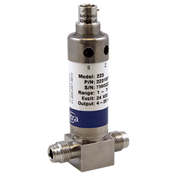
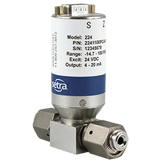
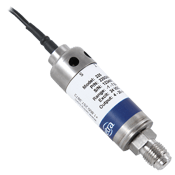
Setra’s Models 223, 224, 225, and 227 are well-suited for semiconductor gas-delivery applications. These products support applications such as specialty gas monitoring, high-purity gas delivery systems, gas cabinets, and modular gas sticks or panels.
For semiconductor OEMs and fab infrastructure teams, the value is practical: accurate, contamination-resistant pressure measurement helps support stable gas delivery where cleanliness, leak integrity, and repeatability are essential.
| Model | Application fit |
|
|
Flow-Through Pressure Transducer designed for the most demanding specialty gas monitoring and control applications, where construction integrity, purity, and performance cannot be sacrificed |
|
|
Flow-Through Pressure Transducer designed to provide superior mechanical and thermal stability, especially in transient temperature conditions resulting from flowing gases. Isolation of the sensing element from the pressure fitting virtually eliminates any torque effect. |
|
|
Ideally suited for high-purity gas delivery systems, each sensor is helium leak-tested by mass spectrometry and designed with a low cavity volume, virtually eliminating particle entrapment and enabling the 225 to be easily purged. |
|
|
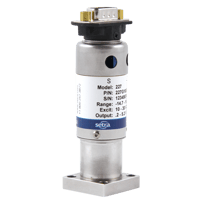
Designed for high-density modular gas sticks and panels, the Model 227 features a compact 1-1/8-inch footprint, downmount C-seal, and small swept sensor chamber for easy purging and precise gas delivery in 300 mm process tools. |
The Yield Connection
Yield improvement comes from reducing variation across the manufacturing process. Accurate pressure measurement helps address one part of that challenge by supporting stable gas delivery, cleaner purge cycles, leak integrity, and consistent process conditions. NIST directly connects accurate semiconductor gas metering with throughput and yield, while external semiconductor manufacturing sources also link gas delivery, contamination reduction, and pressure control to wafer quality, productivity, and optimized yields.
In critical semiconductor environments, the right UHP pressure transducer helps provide confidence that gas delivery systems are operating as intended, from the gas cabinet to the process tool.